


WS K88

Erich's new place where different things will happen, but still the center of the universe and the navel of the world
Showing posts with label Chinese Culture. Show all posts
Showing posts with label Chinese Culture. Show all posts
Aug 30, 2012
The Mid- Autumn Festival close.
Don't forget to visit Chinatown to experience Chinese culture, fun events, great food and wonderful photo opportunities during the Mooncake Festival. Check out www.chinatownfestivals.sg for detailed information on all the events.


Jan 25, 2012
Fun Performance or Highly Offensive to Tradition?
Power packed Lion Dance Performance
This “Lion dance” performance in Chinatown a while ago caused some heated discussions.
Here are some of the pro and contras:
“... a fun performance - it's not really a lion dance...”
"i'm sure they meant no offence by this, although i can see how you might be a bit put off, if you're a purist.”
“...as a lion dancer myself for over 15 yrs, this is highly offensive to the traditional style and a slap in the face of those traditions..."
“... this is ridiculous. its not dancing, neither is it funny to poke fun at the asian culture...”
“...strange mix of different cultures, and I'm sure many people of the older generation were probably turned off by it...
“..This is like FRIGGING AWESOME! Its not easy to do such dance while carrying that big lion head. GREAT JOB!! “
“...That was fun and energetic, though not traditional...”
“...Cool course it's not the same as traditional lion dance ,but it's very inventive...”
“ ...It's really taking the art of the lion dance and giving it new life! Everyone has seen a
traditional lion dance and these guys made it relevant to people today! Awesome!”
“ ...But putting a ballet tutu on the lions is just a mockery. So messy and just terrible. Lions are supposed to be majestic and dignified but apparently someone has gotten these lions...”
“ ...like it or not, these people probably attracted more crowd than any other local lion dancers out there. have an open mind people ;)...”
“... aww cmon it's entertainment! and it's awesome! it's just a hybrid between different genres of dance and different traditions. nothing wrong with that. plus it's not as if singaporean chinese upkeep all the traditions that our forefathers did in the past too.
This “Lion dance” performance in Chinatown a while ago caused some heated discussions.
Here are some of the pro and contras:
“... a fun performance - it's not really a lion dance...”
"i'm sure they meant no offence by this, although i can see how you might be a bit put off, if you're a purist.”
“...as a lion dancer myself for over 15 yrs, this is highly offensive to the traditional style and a slap in the face of those traditions..."
“... this is ridiculous. its not dancing, neither is it funny to poke fun at the asian culture...”
“...strange mix of different cultures, and I'm sure many people of the older generation were probably turned off by it...
“..This is like FRIGGING AWESOME! Its not easy to do such dance while carrying that big lion head. GREAT JOB!! “
“...That was fun and energetic, though not traditional...”
“...Cool course it's not the same as traditional lion dance ,but it's very inventive...”
“ ...It's really taking the art of the lion dance and giving it new life! Everyone has seen a
traditional lion dance and these guys made it relevant to people today! Awesome!”
“ ...But putting a ballet tutu on the lions is just a mockery. So messy and just terrible. Lions are supposed to be majestic and dignified but apparently someone has gotten these lions...”
“ ...like it or not, these people probably attracted more crowd than any other local lion dancers out there. have an open mind people ;)...”
“... aww cmon it's entertainment! and it's awesome! it's just a hybrid between different genres of dance and different traditions. nothing wrong with that. plus it's not as if singaporean chinese upkeep all the traditions that our forefathers did in the past too.
stop being so narrow minded singaporeans!!”
WHAT SAY YOU?
WHAT SAY YOU?
Aug 17, 2010
Some very Singlish tips about the 7th month
Credits: Someone who wrote this
How good is your Singlish!?! Understand or not? huh? LOL
1) Dun stay out too late. If there's a need, stay past midnight...
2) Dun step on ashes.. If accidentally step on it, say "Alamak! paiseh la.....dun angrrryyyy l...ehhhh".
3) If some1 call u from behind, turn ur whole body back, instead of just the head if not later sprain ur head then how......
4) If smell funny smell, shout out and say "which ******* manz..better own up hor!"...if not people will mistaken u who fart...
5) Dun let your fringe cover your forehead, later got chiobu u cannot see lah....
6) Dun scold vulgarities at some dark places when u are alone. Scold also scold when there is people around la...dun waste your own breath mah...
7) If a place makes you uncomfortable, keep chanting "Na2 Mo1 Or1 Ni3 Tuo3 Fuo3...first"
8) Avoid going swimming, because now Lunar 7th month....no chiobu leh...no one to show off body to...
9) If there's a pair of shoes in the lift, but no one is in it. Check out the brand first, scarly is HERMES...sell liao still got value..
10) If you see anyone praying and blocking your way, just shout "OIEE....SIAMMM LEHH!"
11) Do not talk to strangers on a deserted stretch of road....in case people say "我不想跟你讲话。。。".
Lastly, "人怕鬼三分,鬼怕人七分" Do not be afraid even if u meet this kind of thing. Don't believe to this crap la...i only hear of 不管三七二十一。。。

Aug 16, 2010
Chinatown Hungry Ghost Festival 2010
Birth, Life & Death in Chinatown Tour - $33 per person (includes GST) (All About Chinese Beliefs, Myths and Taboos)
Saturdays & Sundays (14th, 15th, 28th, 29th of Aug & 4th, 5th of Sept), 4.30pm-8.00pm (dinner provided)
This tour provides you with the lowdown on everything you ever wanted to know about Chinese beliefs, myths and taboos. Guides will walk participants through Chinatown to look at interpretations of traditional Chinese beliefs that are part of the life cycles of birth and death. Tour participants will get opportunities to consult the Almanac and have their fortunes told. There will also be real-life demonstrations performed by priests of the Taoist Federation.
We’ll answer some burning questions too, like why it’s not safe to point at the moon, when it’s perfectly alright to not wash your hair and of course, how to have a great prosperous life

Walking With the Good Brothers Tour : The Hungry Ghost Festival Walk
21st Aug (Sat) and 22nd Aug (Sun), 6pm-9.30pm (dinner provided)
21 Aug: $33 per person (includes GST)
22 Aug : $43 per person (includes GST)
Enter the world of deities, spirits and beliefs of the Hungry Ghost Festival. Our guide will take participants through a mystical evening of the Hungry Ghost festivities in Chinatown. Find out which deity acts as the festival’s ‘policeman’, what secrets lie in the ‘Fa Cai Ang Bao’ (prosperous red packet), watch the rituals and be immersed in the loud and electrifying action of the Getai and Auction Dinner*. Walk with the ‘good brothers’ (a euphemism for the spirits) as they ‘walk’ the earth once more.
* Auction dinner is on 22 Aug only.

Hungry Ghost Festival Exhibition
10 Aug – 7 Sep 2010, Kreta Ayer Square, Free Entry
Staged in partnership with the Taoist Federation (Singapore), this month-long exhibition is an indepth look at the mysteries and significance of the Hungry Ghost Festval as it is celebrated in Singapore.
The exhibition area will be divided into four zones, namely introducing Traditional Chinese Festivals, understanding the Hungry Ghost Festival, Folklore and a photographic exhibition of how Hungry Ghost Festival was celebrated in the past. It will also feature rare photographs of Hungry Ghost Festival celebrations in the 70s and 80s by Mr Ronni Pinsler - a renowned heritage photographer and was recently
recognised by National Heritage Board as a Supporter of Heritage for donating over 15,000 images to the National Archives of Singapore.
Through the exhibition, visitors will better understand the significance of traditional Chinese festivals, and how they are celebrated.
Visitors will be able to sneak a peek into the mysterious world of Taoist rituals and skills, and understand the fundamental purposes of conducting such rituals during the Hungry Ghost Festival. There will also be exhibits on display to introduce the practices around the Zhong-Yuan festival, including rare Taoist relics and scriptures. A ritual appreciation and demonstration on 14 August 2010 will also introduce the salvation (chaodu) ritual to the public.
For details and tour reservations, pls contact:
Ms Toh Mei Lian
Marketing and Promotions Executive
Tel: 6372 0478 Eail: meilian@chinatown.org.sg
Jan 9, 2010
Xmas is just over and soon we celebrate Chinese New Year
 Time flies another year has gone, the "Year of the Ox" will soon be replaced by the "Year of the Tiger".
Of course Chinatown is a key focal point for Chinese New Year festivities in the few weeks leading up to Chinese New Year and a few weeks following that. You
can immerse in the entire Chinese cultural experience and experience the festive hustle and bustle simply by walking the streets of Chinatown.
.jpg) Chinatown with the Night Market plus the festive Street Stalls is also where local Chinese congregate year after year to shop for necessary new year items and to soak in the festive atmosphere.
Chinatown with the Night Market plus the festive Street Stalls is also where local Chinese congregate year after year to shop for necessary new year items and to soak in the festive atmosphere.Find out where and when it is best to visit Chinatown to be part of a fascinating heritage.
Festive Street Stalls, 23 Jan – 13 Feb
• Venue : Pagoda, Smith, Sago, Temple and Trengganu Streets, and People’s Park Complex
Nightly Stage Shows, 23 Jan – 13 Feb
• Venue: Kreta Ayer Square
Chinatown Chinese New Year Celebrations 2010 Countdown on 13 Feb
• Venue: Eu Tong Sen Street & New Bridge Rd
Chinatown Yuan Xiao Jie on 28 Feb
• Venue: Eu Tong Sen Street & New Bridge Road
Erich's Wuerstelstand will again be decorated for the festivities. Stop by to see who's selling sausages this season?
Jan 12, 2009
The "Year of the Earth Ox" begins January 26, 2009 (or the year 4707 in the Chinese calendar)
STURDY, EARTHY, NO-NONSENSE - THAT's THE OX.
Affectionate and easy-going, the Ox can show a fierce temper when agitated. He is neat, tidy, quiet and studious, with a great love of his home. He is a revered animal who also symbolizes diligence, reliability, sincerity, strength and sound judgment. Music can be a great love. Family life and a loving partner are high on the Ox's priorities, a wonderful loyal friend.
But, don't expect these lumbering souls to have a sparkling sense of humor or be style conscious...it's not part of their precious package!
.jpg) ALL YOU EVER WANTED TO KNOW ABOUT THE OX
ALL YOU EVER WANTED TO KNOW ABOUT THE OX
-Position in the Zodiac: 2ndRuling
-Hours: 1:00 - 3:00 am
-Season/Month: Winter, January
-Similar to Western Astrological Signs: "Capricorn" with some features of "Taurus"
-Gemstone: Onyx
-Colors: Yellow and blue
-Polarity: Yin
-Element: Water
-Positive Traits: Calm, dependable, honest, caring, honorable, intelligent, industrious, modest, patient, practical, responsible
-Negative Traits: Petty, inflexible, possessive, dogmatic, gullible, stubborn, critical, intolerant, and materialistic
-Associated With Following Countries: Countries Switzerland, India, Cuba, Yemen, Finland, Ukraine
-Very Compatible with Following Animals: Rat, Snake, and Rooster
-Incompatible with Following Animals: Tiger, Horse, Goat, Rabbit, Monkey

.jpg)


J.S.Bach, Pr.Diana, R. Gere, Napoleon, M. Streep, Whoopi G.
Robert Altman, Hans Christian Andersen, Warren Beatty, Jim Carrey, Charlie Chaplin, George Clooney, Bill Cosby, Tony Curtis, Diana ó Princess of Wales, Marlene Dietrich, Walt Disney, Patrick Duffy, Jane Fonda, Gerald Ford, Michael J. Fox, Peter Gabriel, Dustin Hoffman, Anthony Hopkins, Billy Joel, Don Johnson, Mark Knopfler.
Burt Lancaster, Jack Lemmon, Eddie Murphy, Paul Newman, Jack Nickolson, Billy Ocean, Gwyneth Paltrow, Oscar Peterson, Colin Powell, Robert Redford, Lionel Richie, Rubens, Meg Ryan, Bruce Springsteen, Lady Thatcher, Vincent van Gogh.
Affectionate and easy-going, the Ox can show a fierce temper when agitated. He is neat, tidy, quiet and studious, with a great love of his home. He is a revered animal who also symbolizes diligence, reliability, sincerity, strength and sound judgment. Music can be a great love. Family life and a loving partner are high on the Ox's priorities, a wonderful loyal friend.
But, don't expect these lumbering souls to have a sparkling sense of humor or be style conscious...it's not part of their precious package!
ALL YOU EVER WANTED TO KNOW ABOUT THE OX-Position in the Zodiac: 2ndRuling
-Hours: 1:00 - 3:00 am
-Season/Month: Winter, January
-Similar to Western Astrological Signs: "Capricorn" with some features of "Taurus"
-Gemstone: Onyx
-Colors: Yellow and blue
-Polarity: Yin
-Element: Water
-Positive Traits: Calm, dependable, honest, caring, honorable, intelligent, industrious, modest, patient, practical, responsible
-Negative Traits: Petty, inflexible, possessive, dogmatic, gullible, stubborn, critical, intolerant, and materialistic
-Associated With Following Countries: Countries Switzerland, India, Cuba, Yemen, Finland, Ukraine
-Very Compatible with Following Animals: Rat, Snake, and Rooster
-Incompatible with Following Animals: Tiger, Horse, Goat, Rabbit, Monkey
FORECAST FOR 2009
The Ox will see an overall improvement in his situation during his birth year, particularly enjoying interaction with others, either with friends and family.
A key phrase to bear in mind this year is 'hold fast'. There may be some setbacks or delays, but if the Ox remains calm and persists, all will be well. There will be an opportunity to study and learn (in common with other signs this year) which should appeal to the Ox not to mention the pride that comes with what is achieved. Between May and July there are significant developments on the work front, in particular important talks with a boss or superior, while September to November will see interesting and delightful romantic encounters!
The Ox will see an overall improvement in his situation during his birth year, particularly enjoying interaction with others, either with friends and family.
A key phrase to bear in mind this year is 'hold fast'. There may be some setbacks or delays, but if the Ox remains calm and persists, all will be well. There will be an opportunity to study and learn (in common with other signs this year) which should appeal to the Ox not to mention the pride that comes with what is achieved. Between May and July there are significant developments on the work front, in particular important talks with a boss or superior, while September to November will see interesting and delightful romantic encounters!
OX-CELEBRITIES:

.jpg)


J.S.Bach, Pr.Diana, R. Gere, Napoleon, M. Streep, Whoopi G.
Robert Altman, Hans Christian Andersen, Warren Beatty, Jim Carrey, Charlie Chaplin, George Clooney, Bill Cosby, Tony Curtis, Diana ó Princess of Wales, Marlene Dietrich, Walt Disney, Patrick Duffy, Jane Fonda, Gerald Ford, Michael J. Fox, Peter Gabriel, Dustin Hoffman, Anthony Hopkins, Billy Joel, Don Johnson, Mark Knopfler.
Burt Lancaster, Jack Lemmon, Eddie Murphy, Paul Newman, Jack Nickolson, Billy Ocean, Gwyneth Paltrow, Oscar Peterson, Colin Powell, Robert Redford, Lionel Richie, Rubens, Meg Ryan, Bruce Springsteen, Lady Thatcher, Vincent van Gogh.
Preparations for the “OX YEAR” are on their way
The Chinese method of identifying every year with animals has greatly influenced most people, even those living in western influenced countries. So much is its influence that people’s personality and character are often regarded in relation to their Chinese horoscope more than that of its western counterparts.
.jpg) The 12 animals representing the Chinese calendar years (repeated every 12 years) are: Pig (1911), Rat (1912), Ox (1913), Tiger (1914), Rabbit (1915), Dragon (1916), Snake 1917, Horse (1918), Goat (1919), Monkey (1920), Rooster (1921), and Dog (1922 ).
The 12 animals representing the Chinese calendar years (repeated every 12 years) are: Pig (1911), Rat (1912), Ox (1913), Tiger (1914), Rabbit (1915), Dragon (1916), Snake 1917, Horse (1918), Goat (1919), Monkey (1920), Rooster (1921), and Dog (1922 ).
In the Chinese year, 2008 was represented by the Rat, while 2009 will be the year of the Ox, which will start on the 26th of January, the first new moon of the year. This will mark the beginning of the 15-day festivities, which will continue until February 9, 2009.
 Preparations are already undergoing to make the celebration of the entry of the year of the Ox a magnificent one.
The 12 animals representing the Chinese calendar years (repeated every 12 years) are: Pig (1911), Rat (1912), Ox (1913), Tiger (1914), Rabbit (1915), Dragon (1916), Snake 1917, Horse (1918), Goat (1919), Monkey (1920), Rooster (1921), and Dog (1922 ).In the Chinese year, 2008 was represented by the Rat, while 2009 will be the year of the Ox, which will start on the 26th of January, the first new moon of the year. This will mark the beginning of the 15-day festivities, which will continue until February 9, 2009.
 Preparations are already undergoing to make the celebration of the entry of the year of the Ox a magnificent one.
 Traditional pineapple tarts and other CNY cookies are baked. People are buying New Year cloths and new shoes.
In old China people started well in advance of the New Year's Day. The 20th of the Twelfth Moon was set aside for the annual housecleaning, or the "sweeping of the grounds". Every corner of the house must be swept and cleaned in preparation for the New Year.
Spring Couplets, written in black ink on large vertical scrolls of red paper, 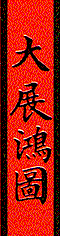

 were put on the walls or on the sides of the gate-ways. These couplets, short poems written in Classical Chinese, were expressions of good wishes for the family in the coming year. In addition, symbolic flowers and fruits were used to decorate the house, and colorful New Year pictures (NIAN HUA) were placed on the walls.
GodAfter the house was cleaned it was time to bid farewell to the Kitchen God, or Zaowang. In traditional China, the Kitchen God was regarded as the guardian of the family hearth. He was identified as the inventor of fire, which was necessary for cooking and was also the censor of household morals.
 According to legend, the Kitchen God leaves the house on the 23rd of the last month to report to heaven on the behavior of the family during the last year. A negative report by the Kitchen God means a family will suffer from bad luck during the year to come.
In order to ensure a favorable report from the Kitchen God, the custom evolved of feeding him Sticky Cake (Nian Gao). Some said this was either a bribe, or simply a means of ensuring the Kitchen God's mouth was too full of cake to pass on an unfavorable report. Sticky Cake is steamed (as are most Chinese cakes) and made with glutinous rice flour and dried fruit. Traditionally, Sticky Cake is made with peen tong a traditional Chinese brown candy that is available at Asian markets (the glutinous rice flour can also be found at Asian markets).At this time, the family did everything possible to obtain a favorable report from the Kitchen God. On the evening of the 23rd, the family would give the Kitchen God a ritualistic farewell dinner with sweet foods and honey. Some said this was a bribe, others said it sealed his mouth from saying bad things.
Jan 4, 2009
Chinese New Year Celebrations Started With A Blast
.jpg) With a deafening noise when 128 strands of firecrackers were fired off and a crowd pleasing, 3 minute, firework the celebrations for Chinese New Year officially started Saturday night.
With a deafening noise when 128 strands of firecrackers were fired off and a crowd pleasing, 3 minute, firework the celebrations for Chinese New Year officially started Saturday night. Deputy Prime Minister Wong Kan Seng, Dr. Lily Neo, MP for Jalan Besar GRC and many other guests were delighted by the different, exciting performances.
Thousands of Singaporeans and tourists followed the 2 hour long spectacle on Eu Teng Son Street. The lanes in Chinatown were more than crowded and the human traffic came to a near breakdown once in a while.

However the mood seemed to be good despite the current economic situation and the uncertain outlook. People are putting their "hope (and happiness)", which is also the celebration theme, in the upcoming lunar new year, the year of the Ox.
 A lot of hope is what people need because the last three Ox years (1973, 1985 and 1997) were dreadful for stock markets. The bulls kind of stayed away from the stock markets whenever their year appeared once every 12 years.
 With economies around the world still suffering from the horrible 2008, the coming Year of the Ox seems to be under the same depressing constellation for the stock markets as the last three Ox years.


The 588 street stalls are also hoping for a good enough mood of the visitors to buy and not only "window shop". One category of business did already quite well on the opening night: The food stalls! Eating, Singaporeans favorite pastime didn't show a slow down at all since there were long queues at almost every food stall in Chinatown.
 A traditional Chinese New Year cake.
Erich's Wuerstelstand was no exemption. It looked like everyone wanted to buy sausages and bread from the "crazy" ang moh who changes his looks according to the season and after Santa is now a "Chinaman".
 Erich always smiling despite the stressful weeks ahead.
 "Chilly, Mustard, Ketchup?"
 " Ta pao or eat here?"
 Eu Tong Sen Street
.jpg) If you want to learn more about the ox year, keep it here and check out the next posts.
If you want to learn more about the ox year, keep it here and check out the next posts.
Dec 29, 2008
Time is flying
We are just done with Christmas celebrations and since last week busy workers are have been setting up lights and decorations for Chinese New Year festivities.
The offcial "Light up" will already be on Jan. 3rd and the closing act wil be on February 15. The actual Chinese New Year is January 26 + 27.
So we say good buy to Xmas and winter 2008 and.jpg) welcome 2009 and with the first new moon the year of the OX
welcome 2009 and with the first new moon the year of the OX
.jpg)
The offcial "Light up" will already be on Jan. 3rd and the closing act wil be on February 15. The actual Chinese New Year is January 26 + 27.
So we say good buy to Xmas and winter 2008 and
welcome 2009 and with the first new moon the year of the OXAug 31, 2008
Ullambana or Hanging the "Lantern of Life" Festival

Buddhists are celebrating this Ullambana festival hanging the “Ksitigarbha Life-Prolonging” Lantern to brighten up the world of all sentient beings.
 In many Buddhist scriptures, lanterns and lamps represent the Wisdoms of Buddhas and Bodhisattvas. As the “Lamp of Continual Light” symbolizes the mind of Enlightenment, therefore, every practitioner in search of liberation contemplates their bodies as the lamp stand, their minds as lamp bow and their faith as lamp wick. The significance of hanging the “Ksitigarbha Life-Prolonging” Lantern during Ullambana Festival is to transmit to all beings the light of powerful vows made by Ksitigarbha Bodhisattva.
In many Buddhist scriptures, lanterns and lamps represent the Wisdoms of Buddhas and Bodhisattvas. As the “Lamp of Continual Light” symbolizes the mind of Enlightenment, therefore, every practitioner in search of liberation contemplates their bodies as the lamp stand, their minds as lamp bow and their faith as lamp wick. The significance of hanging the “Ksitigarbha Life-Prolonging” Lantern during Ullambana Festival is to transmit to all beings the light of powerful vows made by Ksitigarbha Bodhisattva. 
Life-Prolonging Ksitigarbha is one of the manifestations of Ksitigarbha Bodhisattva. Having taken a vow to help all beings to prolong their life, he blesses one with longer lifespan and avoid premature death. May the supreme virtues and merits of lamp offering bless all beings to obtain happiness, free from suffering, illness, calamities and epidemics, enjoy longevity and may all wishes of sentient beings be fulfilled.
Mid Autumn Festival also known as Chinese Moon Festival
 The Mid-autumn Festival also known as Chinese Moon Festival is celebrated on the 15th moon day of 8th Chinese lunar month which is the 14 September in 2008.
The first day of 8th lunar month this year is 31st August.
Moon cakes have played a central role in Moon Festival traditions. Once, according to Chinese legend (not necessarily supported by historical records), moon cakes helped bring about a revolution. I was during the Yuan dynasty (AD 1280-1368), when the Mongolians invaded from the north and subjugated the Han Chinese. The rebel leader Zhu Yuanzhang (left) who plotted to overthrow the tyrannical rule of the Yuan dynasty sought permission from Mongolian leaders to give gifts to friends as a symbolic gesture to honor the longevity of the Mongolian emperor.
 These gifts were round moon cakes. Inside, Zhu had his followers place pieces of paper with the date the Han Chinese were to strike out in rebellion to overthrow the Mongols, thus ending the Yuan dynasty -- on the fifteenth night of the eighth month. These days lanterns were used at night as signals from higher grounds and hilltop.
Hence today, far from the exotic and heroic legends, Chinese communities all over the world make, consume and exchange as gifts these moon-shaped pastries with sweet fillings of red bean and lotus seed paste, during the traditional autumn Moon Festival.
This is a day to worship the moon god an according to folk legend it is also the birthday of the earth god (T'u-ti Kung). The Chinese believe in praying to the moon god for protection, family unity, and good fortune.
 The moon festival signals that the year's hard work in the fields will soon come to an end, with only the harvest left to attend to. People use this opportunity to express their gratitude to heaven (represented by the moon) and earth (symbolized by the earth god) for the blessings they have enjoyed over the past year. Traditionally, on this day, Chinese family members and friends will gather to admire the bright mid-autumn harvest moon, and eat moon cakes and pomelos together. The round "moon cakes" are symbolic of family unity and closeness.
 Pomelos are also eaten on this day. The Chinese word for "pomelo" or "grapefruit" is yu, which is homophonous with the word for "protection," yu, expressing the hope that the moon god give them protection. Moon gazing is another essential part of this festival. On this day, the moon is at its roundest and brightest. This is also a time for lovers to tryst and pray for togetherness, symbolized by the roundness of the moon. Lanterns were used at night as signals from higher grounds and hilltop.
 Today, this festival is celebrated with moon cakes and lantern hanging on the house. The lantern and the moon cakes have attracted many children and adults attention. In certain area, lantern procession and competition are held.
  In Singapore the Chinese Garden is the special venue for this most beautiful of all the Chinese festivals.
 Many traditional festivals all over the world have been transformed into highly commercial ones and lots of kitsch is displayed for sale.
I definitely can't find any link between Chinese tradition, moon cakes or lanterns and David Beckham, can you?


Even this "white" guy has no resemblance with any ancient customs, however he is probably the most renown and popular "ang moh" in the Chinatown Night Market.
Jan 27, 2008
The 15-Day Celebration of Chinese New Year (CNY)
On the second day, the Chinese pray to their ancestors as well as to all the gods. They are extra kind to dogs and feed them well as it is believed that the second day is the birthday of all dogs.
The third and fourth days are for the sons-in-laws to pay respect to their parents-in-law.
The fifth day is called Po Woo. On that day people stay home to welcome the God of Wealth. No one visits families and friends on the fifth day because it will bring both parties bad luck.
On the sixth to the 10th day, the Chinese visit their relatives and friends freely. They also visit the temples to pray for good fortune and health.
Jade GodThe third and fourth days are for the sons-in-laws to pay respect to their parents-in-law.
The fifth day is called Po Woo. On that day people stay home to welcome the God of Wealth. No one visits families and friends on the fifth day because it will bring both parties bad luck.
On the sixth to the 10th day, the Chinese visit their relatives and friends freely. They also visit the temples to pray for good fortune and health.
 The seventh day of the New Year is the day for farmers to display their produce. These farmers make a drink from seven types of vegetables to celebrate the occasion. The seventh day is also considered the birthday of human beings. Noodles are eaten to promote longevity and raw fish for success.
On the eighth day the Fujian people have another family reunion dinner, and at midnight they pray to Tian Gong, the God of Heaven.
The ninth day is to make offerings to the Jade Emperor.
The 10th through the 12th are days that friends and relatives should be invited for dinner. After so much rich food, on the 13th day you should have simple rice congee and mustard greens (choi sum) to cleanse the system.
 The 14th day should be for preparations to celebrate the Lantern Festival which is to be held on the 15th night.
 New Year's Eve and New Year's Day
 New Year's Eve and New Year's Day are celebrated as a family affair, a time of reunion and thanksgiving. The celebration was traditionally highlighted with a religious ceremony for "the welcoming of the gods of the heavens and earth, the gods of the household and the family ancestors". Many people abstain from meat on the first day of the new year because it is believed that this will ensure long and happy lives for them.
The sacrifice to the ancestors, the most vital of all the rituals, united the living members with those who had passed away. Departed relatives are remembered with great respect because they were responsible for laying the foundations for the fortune and glory of the family. The presence of the ancestors is acknowledged on New Year's Eve with a dinner arranged for them at the family banquet table. The spirits of the ancestors, together with the living, celebrate the onset of the New Year as one great community. The communal feast called "surrounding the stove" or weilu. It symbolizes family unity and honors the past and present generations.
The eve of CNY is probably the high point of the celebration as it is on this day that family members from far and near will return home for the reunion dinner, to rekindle family ties and enjoy the sumptuously prepared meals. Dinner is usually made up of seafood and dumplings; delicacies include waxed duck, prawns, braised dried oysters, scallops and “prosperity vegetables”.  After the reunion feast, entire families will try to stay up all night in adherence to shou sui, a practice which is believed to bring one's parents longevity. To while away the hours, it is common for many to gamble; the sound of mahjong chips clattering against each other throughout the night is not uncommon.
At the stroke of midnight, the New Year is ushered in. Firecrackers and fireworks are prohibited, so the requisite din to herald the New Year falls upon human voices and song, and modern “improvisations” such as the recorded sounds of exploding firecrackers.
After the reunion feast, entire families will try to stay up all night in adherence to shou sui, a practice which is believed to bring one's parents longevity. To while away the hours, it is common for many to gamble; the sound of mahjong chips clattering against each other throughout the night is not uncommon.At the stroke of midnight, the New Year is ushered in. Firecrackers and fireworks are prohibited, so the requisite din to herald the New Year falls upon human voices and song, and modern “improvisations” such as the recorded sounds of exploding firecrackers.
 With daylight, homes again become a buzz of activity. Ceremonial candles are lit, incense burned, new clothes (red is the custom) are put on, and greetings of “Gong Xi Fa Cai - Kong Hee Fatt Choy” or “nian nian you yu” (which means “may every year be filled with extras”) are made. Families visit each others houses exchanging gifts of mandarin oranges which symbolizes gold or wealth. Another custom for married couples is to give children and unmarried adults money inserted in red packets known as ang pow, as a gesture to mean that the recipient will enjoy a fruitful and wealthy life.

Subscribe to:
Posts (Atom)


 Posts
Posts


